

A new habit tracker experiment
Track not if you’ve done the thing, but how you feel about what you’ve done.


Around November last year, I realized that I’d fallen off my habit to keep tracking things I do on my phone app1.
That’s a very normal cyclical thing: on a regular basis, I get the inspiration to renew my habit tracking system. I adjust the whole thing and follow through for quite a while, even for a few months—then life gets in the way and I let everything go… Until a new surge of inspiration takes a hold of me.
It used to bother in the past, as if stopping the habit tracking was some kind of failure. Now… I don’t care that much anymore? I kind of expect myself abandoning my trackers after a while. And I expect myself to happily get back to them after another while.
Somehow, I’m okay with that. With every new surge of inspiration, I consider what I did last and what I want to do differently this time, and I tinker and adjust my systems to try something new. It’s fun for me—it something that I enjoy spending time thinking and wondering about (LOL is habit tracking a hobby of mine?).
The fascination of Habit Trackers
I know it seems like a platitude when I say: you can still be a productive writer when you don’t write every day, you can still have meaningful relationships when you don’t talk to your friends every day, and you can still be healthy and fit when you don’t eat self-made food nor train every day. Platitude as it might be, I feel it should be said anyway, and it should be repeated as many times as needed for you to internalize it.

Robin Wren wrote a wonderful post in which they describe out how much better and more productive they feel since getting rid of habit trackers—and why. It’s great, you should totally check it out.
And I agree wholeheartedly with what they wrote. Still, I can’t quite let go of my tracker obsession 😆
It really feels like a riddle that I want to solve—I feel there’s a way to make them work, but not in their “classic”, mainstream way. I’ve already written on what a game-changer was for me to tweak my mindset about them: using them not as a motivator, but simply as an objective, non-judgmental collector of data.

As I wrote in my last post: I don’t believe that trackers are for everyone. You should use them if they are helpful and avoid them if they make you anxious (groundbreaking, I know).
And still.
Here I was, in November 2025, taken by a new surge of inspiration. This time, I wanted to come up with something new—I wanted to create a different type of tracker.
The superficiality of habit trackers
Trackers are simple. You have a calendar, a row of slots, a piece of paper, an app, and you add a cross whenever you’ve done the thing you want to turn into a habit. The goal is to keep on adding crosses, every day, forever.
You did the thing = good!
You didn’t do the thing = bad!
That’s straightforward. Easy to grasp. And somewhat superficial.
You will miss a day, eventually. You’re bound to. And, when that happens, the trackers tells you, “bad!”.
Is it bad, though?
I don’t know that it is. It’s so arbitrary.
Let’s say you want to do 10.000 steps a day. Yesterday you managed only 5.000, though. According to the tracker, that’s BAD. You didn’t do the thing.
But it’s still a result. And maybe, if you think about the day, you don’t know that you could have done any better. Maybe you weren’t having a good day to begin with, and are deep down proud you got those 5k done. Maybe, instead of walking, you took the time to prepare a good meal for yourself—and isn’t that a good thing for your health anyway?
The dark side of tracking a particular behavior is that we become driven by the number rather than the purpose behind it. […] This pitfall is evident in many areas of life. We focus on working long hours instead of getting meaningful work done. We care more about getting ten thousand steps than we do about being healthy. We teach for standardized tests instead of emphasizing learning, curiosity, and critical thinking. In short, we optimize for what we measure. When we choose the wrong measurement, we get the wrong behavior. […] Measurement is only useful when it guides you and adds context to a larger picture, not when it consumes you. Each number is simply one piece of feedback in the overall system.
Atomic Habits by James Clear, page 203
For a while, I feel like I could avoid this pitfall by treating trackers as purely a collector of data. Their goal isn’t to motivate or demotivate you, their goal is to track—they are there to tell you the objective status of your habits. They give you information on what you’ve been able to do, for how long, and how often, and that’s supposed to help you set for yourself realistic goals for the future.
I liked that. Until I had a thought.
What happens if I strip my habit trackers of their most well-known and seemingly valuable characteristics? Trackers are objective. They show facts.
But… What if I made them subjective? What if I used them to track something vague and non-measurable, maybe even contradictive? What would happen then?
Track not if you’ve done the thing, but how you feel about what you’ve done
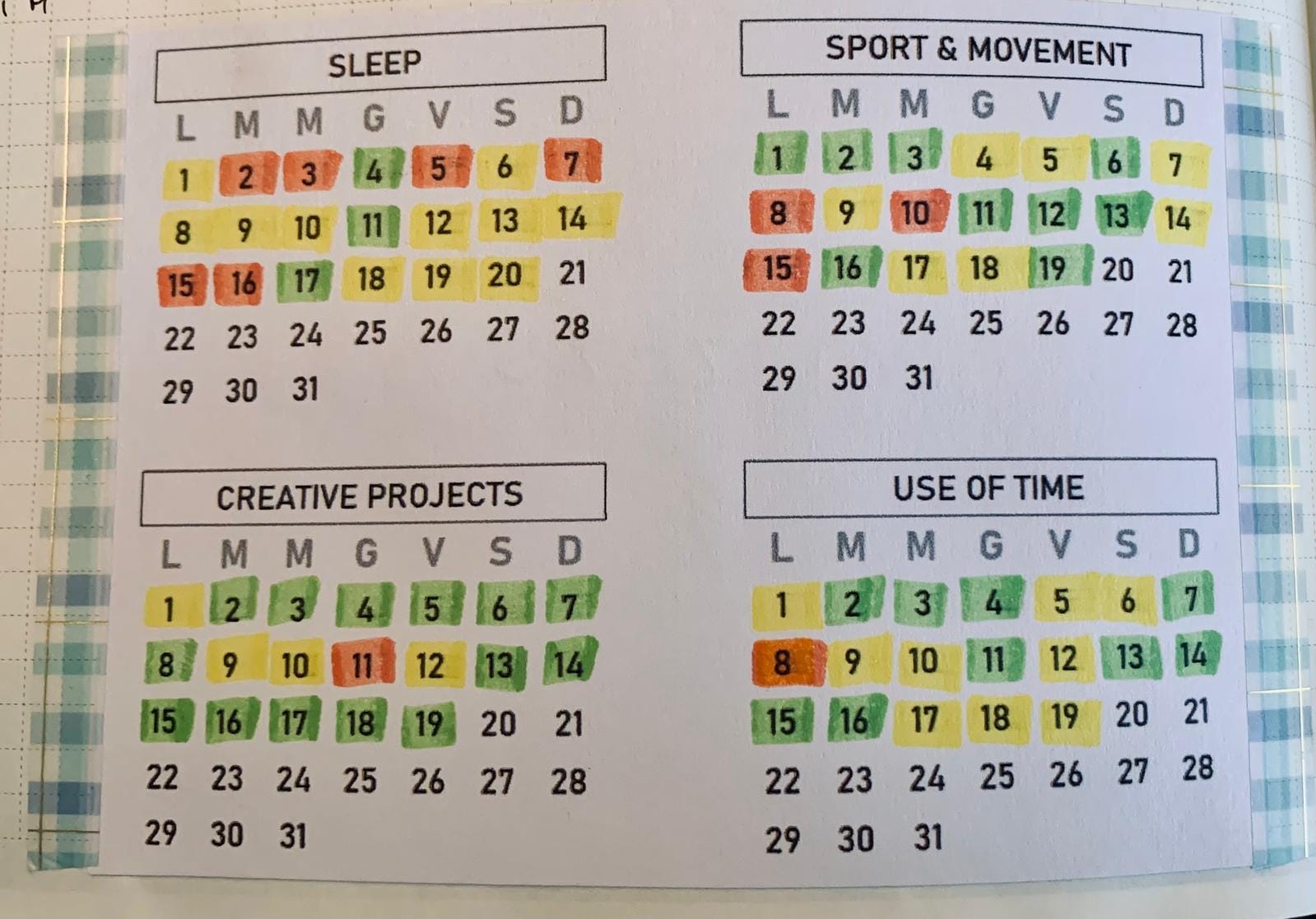
This is my December 2025 Tracker.
I identified four main categories in my life that I want to keep an eye on. For each, I ask myself the following questions:
💤 Sleep: How well did I sleep tonight?
🏃🏻♂️ Sport & Movement: Did I do some sport and/or movement and how do I feel about it?
🖋️ Creative Projects: How do I feel about what I did for my novel/newsletter/other creative endeavours?
⏱️ Use of time: How satisfied am I on how I generally used my time today?
Then, depending on the answer, I color the day accordingly:
🟩 Green: I’m satisfied
🟨 Yellow: It’s alright
🟥 Red: I’m not satisfied
I’m not tracking if I did or didn’t do something specific, but more generally how I feel about a broad category of my daily life.
It’s been an interesting exercise. First of all, it makes me think more about what I’ve done and whatnot. Filling up the tracker isn’t anymore a yes/no answer—it has a few layers more, now.
It creates for interesting outcomes, too. I have to interrogate myself about my feelings—and feelings are contradictive. Maybe on my free day I wrote for my novel a good 500 words, but I know I spent the rest of the afternoon scrolling YouTube shorts when I could have done more: I wrote something, but I’m not quite happy with it. Yellow (and a glaring red for Use of Time. Sometimes I think it would be better I spent the time gaming, rather than scrolling 🫠).
Maybe one day I managed to only open my Scrivener project and edit the last few sentences I’ve written—but you know what? I haven’t been writing for weeks and I need time to get back in the right mindspace. I didn’t write shit, but I’m still satisfied with what I did. Green.
It’s an exercise of giving myself grace. Or a kick in the butt. It’s… ugh, not really measurable. And terribly subjective.
But there’s something I dig about it. It’s an exercise in awareness. I want to know how these categories of my daily life are proceeding—how I feel they are proceeding. I think there’s still an interesting value in it.
I don’t know that I would recommend this style of tracking to everyone, actually. I can imagine it can be tough for perfectionists, or for those who tend to be very harsh towards themselves. But then, maybe this can be a good method to train self-compassion?
I’m genuinely not sure. What do you think?
As you can see, I’m still figuring it out myself. I’d love to hear your thoughts on it! You can let me know by simply replying to this email, writing me at ryeyoubs@gmail.com, or leaving a comment.
Also, everything on Rye & Writing is currently free—nothing is behind a paywall. But if you like what I’m doing and you’d like to support me, feel free to drop a little donation. You’ll have my eternal gratitude ❤️
Thank you for reading and take care!
Rye
Let me put in this way:
...maaaaybe? ;)
This is definitely an interesting take on tracking, and if the goal is to exercise mindfulness in a few chosen areas of life, it can definitely work well.
I found this quote by James Clear incredibly fitting - it has not occurred to me that maybe one should spend some time questioning whether they are even tracking the correct thing considering the actual goal they want to achieve.
For instance, when writing a novel, tracking word count seems like a no-brainer, yet there is actually only one phase of working on a novel where word count matters, which is writing the first draft. And even then one often needs to take a break from writing and use a writing session for planning, outlining, reassessing the direction, staring at the wall...
No, progress on the novel-writing thing is way more complex than "x words down on paper".
I guess that's why, among many other things, I have given up on tracking. It makes my lil brain hurt ;)
I love the experiment! Great out of the box thinking!